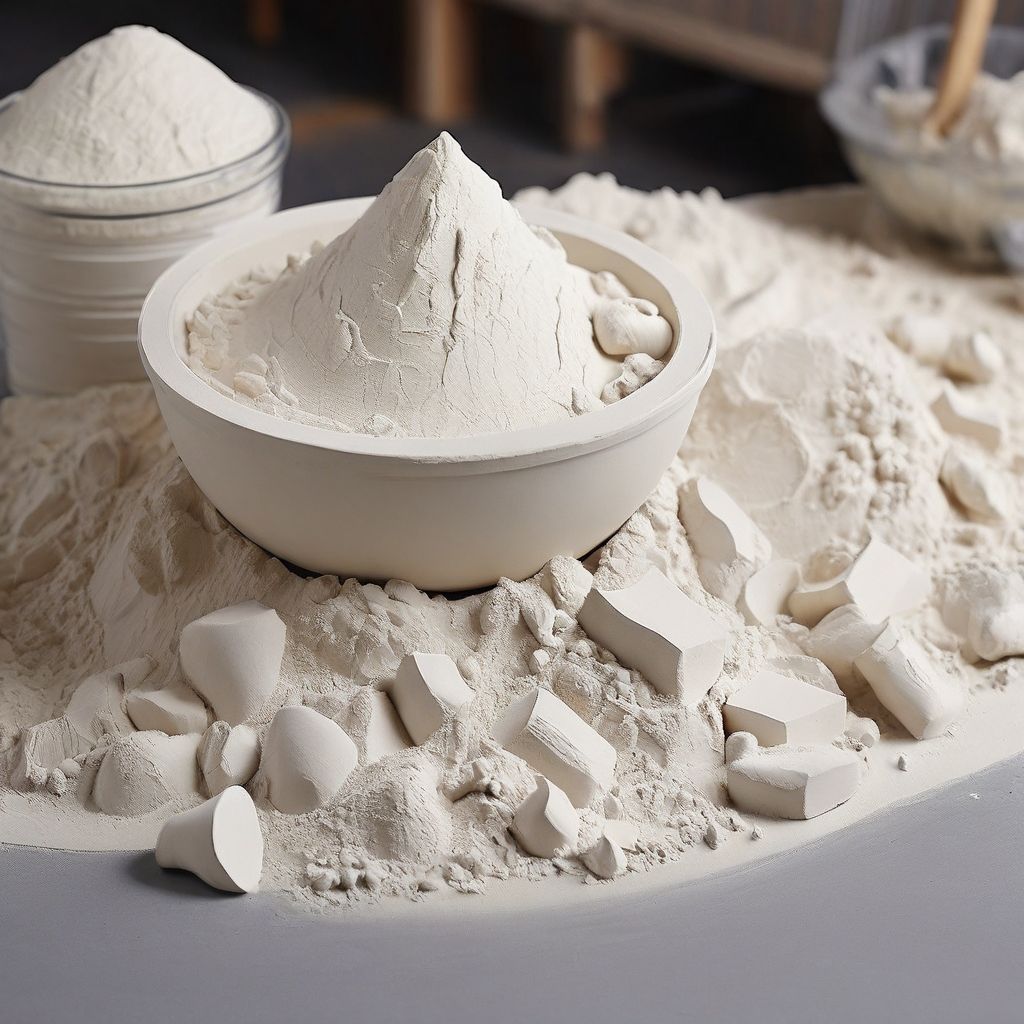
Plaster of Paris looks deceptively simple — a fine white powder that sets when mixed with water. But behind that bag is a multi-step industrial process that transforms a soft mineral pulled from the earth into a precisely engineered construction material. Here's how it actually happens, from quarry to finished product.
From Rock to Powder: The Source
It all starts with gypsum — calcium sulphate dihydrate, a soft sedimentary mineral that occurs naturally in large deposits across the world. Gypsum can also be obtained as a byproduct of flue-gas desulphurisation in thermal power plants (so-called FGD gypsum), which is chemically identical to mined gypsum but typically purer.
India has substantial natural gypsum reserves in Rajasthan, Gujarat, Tamil Nadu, and Jammu & Kashmir. These regions supply the bulk of the country's POP and gypsum-plaster manufacturing.
Mining the Gypsum
Most gypsum is extracted from open-pit mines. The mineral sits in horizontal layers near the surface, so quarrying is straightforward — strip the overburden, drill, blast lightly, and load the rock into trucks. Underground mines exist for deeper deposits, but they're less common because surface gypsum is plentiful.
Quality at this stage matters enormously. Visible impurities — clay seams, iron oxide stains, or anhydrite pockets — are sorted out by hand or by visual scanning before the rock leaves the mine. The cleaner the input, the whiter the finished plaster.
Crushing and Drying
At the manufacturing plant, large gypsum rocks first go through a primary crusher that breaks them down to chunks roughly the size of a fist. Secondary crushers reduce that further to gravel-sized pieces.
Crushed gypsum is then dried to remove surface moisture before the calcination step — wet rock would produce inconsistent heating and uneven product. Dryers typically run at around 90–110 °C, hot enough to flash off water but well below the temperature where the chemistry of the gypsum changes.
Calcination — The Heart of the Process
Calcination is the chemical reaction that turns gypsum into Plaster of Paris. Get this step right and you have a quality product; get it wrong and the bag is worthless.
The dried gypsum is fed into a calciner — typically a rotary kiln, kettle, or fluidised-bed reactor — and heated to around 150 °C. At that temperature, three out of four of the chemically bound water molecules in calcium sulphate dihydrate (CaSO₄·2H₂O) break free and escape as steam, leaving behind calcium sulphate hemihydrate (CaSO₄·½H₂O):
CaSO₄·2H₂O → CaSO₄·½H₂O + 1.5 H₂O ↑
That hemihydrate is what we call Plaster of Paris. It's a metastable form — stable in the bag, but eager to grab water back when you mix it. That's why POP sets so quickly when wet.
Calciner type matters for the final product:
- Kettle calciners produce the finest, purest POP — ideal for casting and decorative work
- Rotary kilns handle larger volumes — common for construction-grade plaster
- Fluidised-bed reactors give the most uniform particle size — preferred for premium gypsum plasters
Grinding to Fineness
After calcination, the hemihydrate goes through one or more grinding mills — typically ball mills or roller mills — that pulverise it to a fine powder. The finer the grind, the smoother the final plaster surface.
Construction-grade POP is typically ground to pass through a 100-mesh sieve (~150 micron). Premium ceiling-grade and casting-grade products go finer, often to 200 mesh (~75 micron) or below.
For modern gypsum plasters, additives are blended at this stage:
- Set retarders (citric acid, plant proteins) for longer working time
- Lightweight aggregates (perlite, vermiculite) for thermal insulation
- Bonding agents for better adhesion
- Workability enhancers like cellulose derivatives
Quality Control
Before any plaster reaches a bag, it's tested. Standard quality checks include:
- Setting time — using a Vicat needle penetration test
- Compressive strength — measured on small cured cubes
- Whiteness index — measured with a colorimeter
- Free water content — to confirm complete calcination
- Particle size distribution — measured by sieve analysis or laser diffraction
Any batch that fails the spec is reblended or rejected. Tight controls here are the difference between a contractor-grade bag and a premium one.
Bagging, Storage, and Distribution
Approved plaster is finally fed into automated bagging machines that fill moisture-resistant bags — typically 25 kg or 40 kg — and seal them. Because gypsum-based plasters are hygroscopic (they absorb moisture from the air), packaging integrity is critical. A bag that develops a tear loses fineness and starts to set unpredictably within weeks.
Sealed bags are palletised, shrink-wrapped, and stored in dry warehouses before going out to dealers and project sites. From mine to construction site, the whole process takes anywhere from a few days for a streamlined plant to a couple of weeks for one with longer batch testing cycles.
At Shankra Plaster, we run every batch through this sequence with consistency checks at each stage — that's the reason every bag of Shankra Plaster behaves the same on site, batch after batch. Get in touch for technical specs or a project quote.